Future-Proof Your Career: The Jobs AI Can't Replace
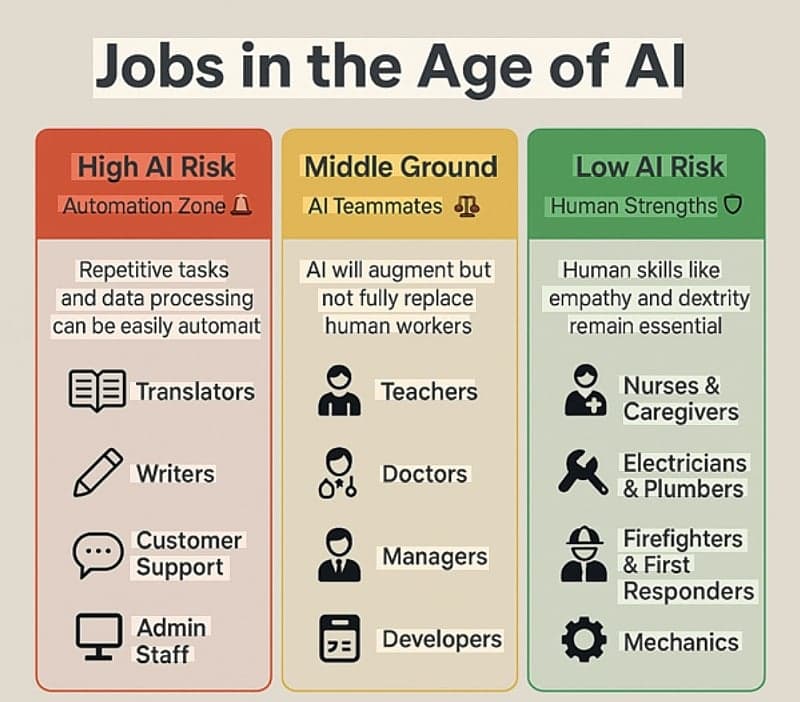
Artificial Intelligence is no longer a distant concept—it is reshaping industries, automating tasks, and redefining what it means to work. From customer service chatbots to AI-driven medical diagnostics, machines are increasingly taking over roles once thought to be uniquely human. But amid this transformation, one question stands out: Which careers are truly 'safe' in the age of AI?
The answer is not as simple as 'jobs that cannot be automated.' Instead, it is about jobs that combine human intelligence, emotional depth, creativity, ethical judgment, and real-world adaptability—areas where AI still struggles to fully replace humans.
The Reality: AI Is Not Just Replacing Jobs—It Is Transforming Them
Before identifying 'safe' careers, it is important to understand a critical truth: AI rarely eliminates entire professions; it automates tasks within them.
- Doctors now use AI to assist in diagnosis, but they still make final decisions.
- Journalists use AI for data analysis, but storytelling remains human.
- Accountants rely on AI tools, but strategic financial advice still requires human judgment.
So the future is not 'human vs AI,' but human + AI collaboration.
Careers That Are More Resistant to AI Replacement
1. Healthcare and Human-Centered Medical Roles
While AI can analyze scans and suggest diagnoses, it cannot replace human empathy, bedside care, or ethical decision-making.
- Doctors and surgeons
- Nurses and midwives
- Psychiatrists and counselors
- Physiotherapists
Why they are safer: Patients need emotional reassurance, trust, and human judgment—things machines cannot authentically provide.
Mind-blowing question: If AI can diagnose you faster than a doctor, would you still trust it with your life decisions?
2. Education and Training Professions
AI can generate lessons, but it cannot replace the human ability to inspire, discipline, and mentor learners.
- Teachers and lecturers
- Special education instructors
- Corporate trainers
- Career coaches
Why they are safer: Education is not just information delivery—it is motivation, psychology, and human connection.
3. Creative and Cultural Industries
AI can generate music, images, and articles—but creativity is more than output; it is lived experience, emotion, and cultural depth.
- Writers and filmmakers
- Musicians and performers
- Graphic designers and brand strategists
- Fashion designers
Why they are safer: Human creativity is driven by emotion, culture, and personal struggle—AI only imitates patterns.
Thought-provoking question: Can a machine truly understand heartbreak well enough to write a timeless love song?
4. Leadership, Strategy, and Decision-Making Roles
AI can provide data, but it cannot take responsibility for consequences or ethical dilemmas.
- CEOs and managers
- Policy makers and government officials
- Business strategists
- Entrepreneurs
Why they are safer: Leadership requires accountability, moral judgment, and vision.
5. Skilled Trades and Physical World Jobs
Many physical jobs require adaptability to unpredictable environments, something AI and robots still struggle with.
- Electricians and plumbers
- Carpenters and builders
- Mechanics
- Farmers using modern agro-tech systems
Why they are safer: Real-world environments are messy, unpredictable, and require hands-on problem solving.
6. Cybersecurity and AI Oversight Roles
Ironically, as AI grows, so does the need to control and secure it.
- Cybersecurity analysts
- AI ethics specialists
- Data protection officers
- Systems auditors
Why they are safer: Every new technology creates new risks—and humans are needed to manage them.
The Emerging 'Hybrid Careers'
The safest future careers may not be purely traditional roles but hybrid human-AI roles, such as:
- AI-assisted doctors
- Data-driven journalists
- Digital marketers using predictive AI tools
- AI system trainers and supervisors
These roles require people who understand both technology and human behavior.
The Big Question: What Kind of Worker Will Survive the Future?
AI forces us to rethink education and skills. The real question is no longer: 'What job should I choose?' But instead: 'What skills make me irreplaceable in any job?'
The most future-proof skills include:
- Critical thinking
- Emotional intelligence
- Creativity
- Communication
- Adaptability
- Ethical reasoning
Final Reflection
AI will not simply take jobs—it will reward those who evolve with it and replace those who refuse to adapt. The safest careers in the age of AI are not defined by job titles, but by human qualities that machines cannot replicate.
So the ultimate question is not whether your job is safe but: Are you becoming the kind of human AI cannot replace?
- #ai
- #futureofwork
- #careeradvice
- #jobsecurity
- #humanskills
Comments · 0